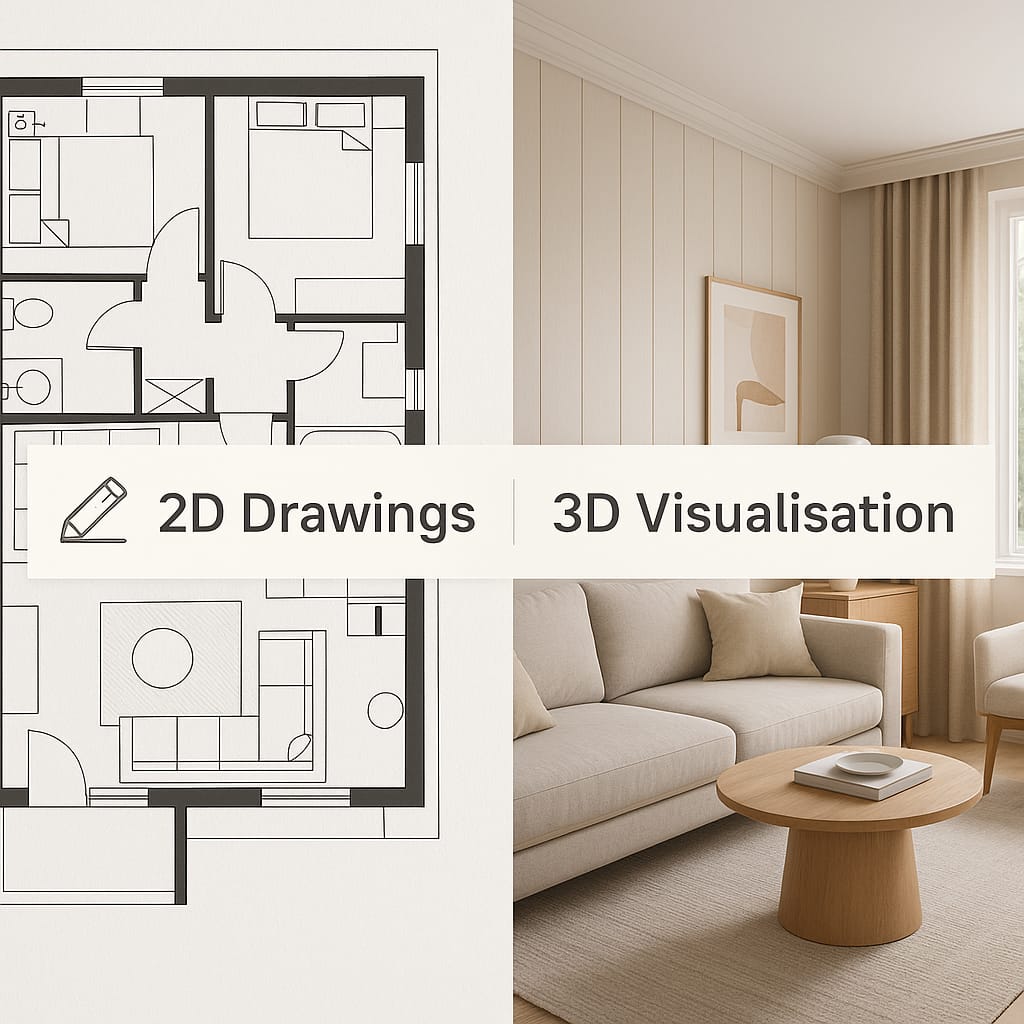

Perspective drawing transforms 2D sketches into realistic representations that bring interior designs to life.
For interior designers, mastering this skill is not just about creating beautiful artwork. Indeed, perspective drawing serves as the crucial bridge between your creative vision and client understanding. When clients struggle to imagine how a space will look based on floor plans alone, a well-executed perspective drawing can make the difference between project approval and rejection.
Many designers find that their projects progress more smoothly when they effectively communicate spatial concepts through perspective. Furthermore, these drawings help prevent costly misunderstandings with contractors and allow for exploration of multiple design options before committing to final decisions.
Whether you’re sketching by hand with traditional tools or using the latest 3D visualization software, understanding the fundamentals of perspective is essential for creating convincing representations of interior spaces. From establishing vanishing points to adding realistic textures, this step-by-step guide will equip you with everything needed to elevate your perspective drawing skills.
Ready to transform your design communication and impress clients with captivating visualizations? Let’s dive into the world of perspective drawing for interior design.
Understanding Perspective in Interior Design
Perspective drawing creates a visual bridge between flat images and three-dimensional reality. This technique forms the backbone of spatial visualization in interior design, allowing professionals to communicate complex spatial ideas effectively.
What is perspective drawing?
Perspective drawing is a technique that creates the illusion of three-dimensional space on a two-dimensional surface [1]. It represents depth, distance, and scale through carefully applied geometric principles. Unlike simple flat drawings, perspective drawings convey how objects appear to the human eye in real space.
The technique works by establishing an invisible grid that helps place objects within a spatial composition, essentially describing 3D space on a 2D plane [2]. At its core, perspective drawing relies on the concept of vanishing points—locations where parallel lines appear to converge as they extend into the distance.
Leonardo da Vinci identified three fundamental aspects of perspective: the apparent diminishing size of objects with distance, the changing appearance of colors as they recede, and the decreasing detail definition in distant objects [3]. These principles collectively create a convincing illusion of depth that mirrors human visual perception.
Why it matters in interior spaces
For interior designers, perspective drawing is invaluable because 2D floor plans often fail to help clients visualize how spaces will look in reality [3]. Consequently, perspective drawings become essential tools for client communication and project development.
Since perspective drawing most closely resembles how humans naturally see and experience the world, it allows architects and designers to effectively explain their ideas to clients and stakeholders who may lack technical training [4]. This visual clarity reduces miscommunication and helps secure project approvals.
Additionally, perspective in interior design addresses how a space is viewed and experienced—encompassing scale, proportion, and spatial relationships between objects and their surroundings [5]. Through perspective techniques, designers can create balanced, harmonious spaces that feel right to inhabitants.
Perspective drawings also serve as powerful study tools throughout the design process. Many professionals use them not just for final presentations but to explore multiple possibilities and combinations during conceptual development [6].
Common types of perspective used.